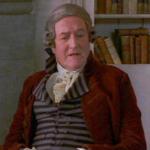
Had lunch today with some friends. Elizabeth was telling me about how much she loves Tulkinghorn from Charles Dickens's Bleak House. I've seen the recent production the BBC did of the novel, and I actually did not find this guy even the least bit attractive, but that's okay. I guess somewhere out there people are shocked that I would find Vincent D'Onofrio, Lee Pace, Jacob Black, Sheldon Cooper and Matthew Gray Gubler attractive.
Isn't that better? I also had lunch with the young woman who lives below me. She is really nice. She was telling me all about this flea market she had tried to go to, getting totally lost in the process and getting bad directions from three different people and it all being a mess. I probably should have asked her about her choice literary bad boys, but I can only take so many shocks a day.
Showing posts with label 19th century literature. Show all posts
Saturday, December 4, 2010
Friday, July 23, 2010
Literary Gentlemen
While on my trip back to school earlier this week, I had the strangest thought: I felt like I could understand the lives of many of the male characters in Jane Austen novels and the other literary gentlemen.
Allow me to explain: A lot of what I understand about how British gentry behaved in the 19th century comes from reading novels and seeing movies from the time period. How accurate to the actual historical breed my imagination has conformed I couldn't tell you.
But as I was there, at Ben's place, having brunch, I found myself thinking that I was much like Colonel Brandon. I was enjoying some time in the country with friends, but because of events at home (a sick relative and a dead friend's father) I was about to race back to the city to attend to business. I very much wanted the riding hat and white horse that Alan Rickman has in the 1995 movie version of Sense and Sensibility so I could arrive home in the city in style.
Yet, when I'm home, sometimes I feel as if I live a double life, like Jack/Ernest from The Importance of Being Earnest. I have potential admirers both in the city and in the country, and I even though I'm not lying about my name to either of them, sometimes I feel like I am very different depending on the place I am.
Of course, this then means I'm not so much like Jack but Jane Eyre, who travels about England in her novel. I'm doing the same, looking for employment whenever I can and even occasionally running away from troublesome men. I guess as long as I don't find myself homeless and wandering the countryside only to exhaust myself in the wilderness like Eyre does at the end of the novel then I'm mostly alright with that.
Over the years, I've found myself comparing my friends and family to various literary characters. I have an uncle, for example, who reminds me of John Middleton. I haven't seen him in almost a year, but he is always throwing parties for the family and I like spending time with him. I had an English teacher who once reminded me of Henry Tilney, in that he was very kind and understanding. I find that I too am severe as Mr. Darcy, and sometimes misunderstood for it.
It's peculiar how I find myself thinking of literary characters in this way. They're not just fictional people I enjoy spending time with when lying on the couch reading, but I think of them as if we exist in parallel universes, separate but not far apart. This speaks to the universality of 19th century characters, and maybe to how little our lives have really changed from characters who were suppose to exist, in some cases, almost two hundred years ago. I don't find myself doing this with many of the other characters I discover, and never for as long.
At the same time, I feel very silly saying all of this, because I can imagine that most literary nerds such as myself feel this way about the characters they read. They become part of their lives, and even though it often sounds silly to an outsider, those characters are like ghosts. They live in our minds, but they exert this bizarre influence on how we view the world and how we choose to interact with it. Perhaps this is a testament to why so many people are afraid of what their children consume culturally, because those ghosts might linger on into their adulthood, and might not be as charming as a bunch of people from two hundred years ago.
Allow me to explain: A lot of what I understand about how British gentry behaved in the 19th century comes from reading novels and seeing movies from the time period. How accurate to the actual historical breed my imagination has conformed I couldn't tell you.
But as I was there, at Ben's place, having brunch, I found myself thinking that I was much like Colonel Brandon. I was enjoying some time in the country with friends, but because of events at home (a sick relative and a dead friend's father) I was about to race back to the city to attend to business. I very much wanted the riding hat and white horse that Alan Rickman has in the 1995 movie version of Sense and Sensibility so I could arrive home in the city in style.
Yet, when I'm home, sometimes I feel as if I live a double life, like Jack/Ernest from The Importance of Being Earnest. I have potential admirers both in the city and in the country, and I even though I'm not lying about my name to either of them, sometimes I feel like I am very different depending on the place I am.
Of course, this then means I'm not so much like Jack but Jane Eyre, who travels about England in her novel. I'm doing the same, looking for employment whenever I can and even occasionally running away from troublesome men. I guess as long as I don't find myself homeless and wandering the countryside only to exhaust myself in the wilderness like Eyre does at the end of the novel then I'm mostly alright with that.
Over the years, I've found myself comparing my friends and family to various literary characters. I have an uncle, for example, who reminds me of John Middleton. I haven't seen him in almost a year, but he is always throwing parties for the family and I like spending time with him. I had an English teacher who once reminded me of Henry Tilney, in that he was very kind and understanding. I find that I too am severe as Mr. Darcy, and sometimes misunderstood for it.
It's peculiar how I find myself thinking of literary characters in this way. They're not just fictional people I enjoy spending time with when lying on the couch reading, but I think of them as if we exist in parallel universes, separate but not far apart. This speaks to the universality of 19th century characters, and maybe to how little our lives have really changed from characters who were suppose to exist, in some cases, almost two hundred years ago. I don't find myself doing this with many of the other characters I discover, and never for as long.
At the same time, I feel very silly saying all of this, because I can imagine that most literary nerds such as myself feel this way about the characters they read. They become part of their lives, and even though it often sounds silly to an outsider, those characters are like ghosts. They live in our minds, but they exert this bizarre influence on how we view the world and how we choose to interact with it. Perhaps this is a testament to why so many people are afraid of what their children consume culturally, because those ghosts might linger on into their adulthood, and might not be as charming as a bunch of people from two hundred years ago.
Subscribe to:
Posts (Atom)